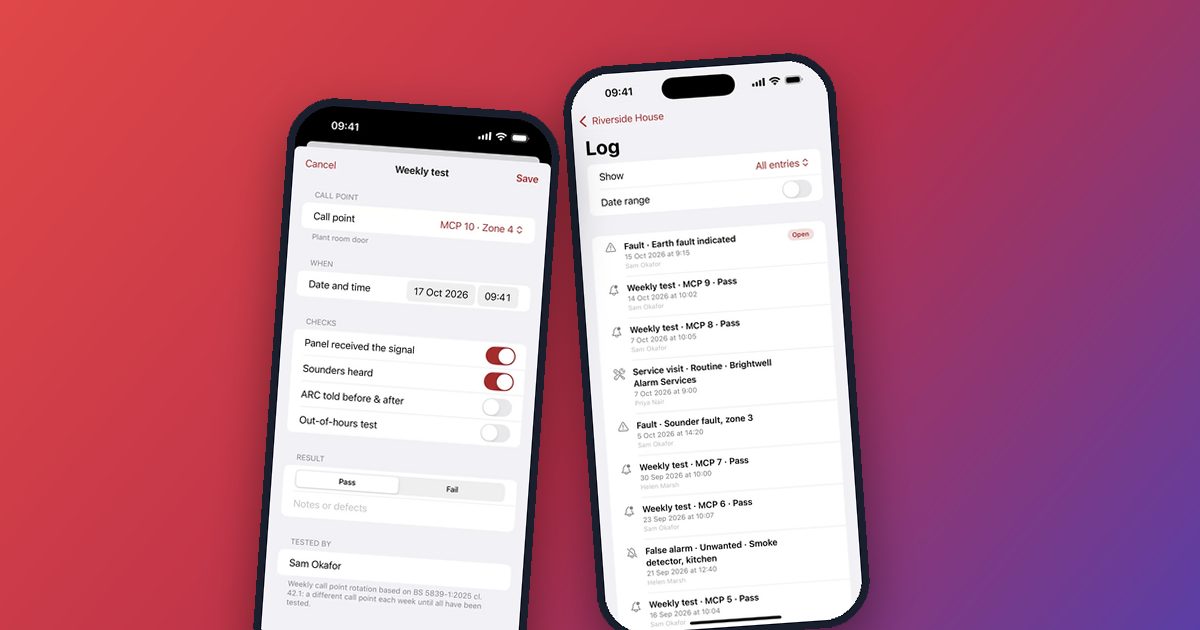
If you look after a building with a fire alarm, you will be expected to keep a log book. It is the running record of what has happened to the system: the tests, the faults, the false alarms and the engineer visits. It sounds like paperwork, and it is, but it is also the first thing an engineer, insurer or inspector will ask to see.
This guide covers what to record in a fire alarm log book, how to handle the weekly call point test, and why a complete, honest log is worth the few minutes it takes. It is written for responsible persons, facilities managers and small business owners in the UK. It is general guidance, not a substitute for your fire risk assessment or advice from a competent fire alarm engineer.
What a fire alarm log book is for
A fire alarm log book is a dated record of everything that affects how your fire detection and alarm system performs. In the UK, BS 5839-1 is the British Standard for fire detection and fire alarm systems in non-domestic premises, and it recommends that records such as a log book are kept. This article is based on that general approach. The standard is published by BSI, so always check the current edition and your own system’s arrangements.
The log serves three purposes:
- It shows the system is being looked after. Anyone checking your fire safety arrangements can see at a glance that testing happens and problems are dealt with.
- It helps your engineer. A record of faults and false alarms shows patterns that a single visit would miss.
- It protects you. If there is ever an incident or a dispute, a clear record is much better than memory.
The weekly call point test
The most regular entry in the log is the weekly test. Someone operates a manual call point (the break-glass or resettable point on the wall) and checks that the system responds as it should. It is a quick check, but the record of it is what makes it count.
Rotate through the call points
The usual practice is to test a different call point each week, so that over time every call point on the system has been tested. That means you need two things: a list of your call points, and a way of knowing which one is next. On a small site you might simply number them on a floor plan. On a larger one, group them by zone or floor.
What to record for each test
For every weekly test, write down enough that someone else could understand what happened:
- The date and time of the test
- Which call point was operated, including its zone or location
- Whether the panel received the signal and indicated the correct location
- Whether the sounders operated
- Whether you told your alarm receiving centre (ARC) before and after, if your system is monitored
- The result, pass or fail, and any notes or defects
- Who carried out the test, with their name or signature
Pick a regular day and time and set a reminder. If you miss a test, do not backfill it: record that it was missed and why, then carry on.
Faults and defects
A fault is anything that means the system is not working as it should: a fault indication on the panel, a failed test, a damaged call point, a sounder that does not operate. Every fault belongs in the log, however minor it seems.
A useful fault entry records:
- When the fault was noticed and by whom
- What was seen, for example the panel indication or the location of the defective device
- What action was taken, including who was told and when
- Any interim precautions put in place while the fault is outstanding
- When it was rectified, and by whom
The last two points are the ones most often missed. A fault that has been logged but never marked as resolved looks like a fault that was ignored. Close the loop every time.
A failed weekly test should lead straight into a fault entry. It is much easier to do this at the moment of the test than to try to reconstruct it afterwards.
False alarms
A false alarm is when the system activates without a real fire. They are disruptive, and a pattern of them is a warning sign that something needs attention. Record each one with:
- The date, time and location
- The device that activated, such as a smoke detector in a kitchen or a call point
- The likely cause, for example cooking fumes, steam, dust, building work, a damaged device or a malicious activation
- What was done in response, and whether the fire and rescue service attended
- Any action taken to stop it happening again
Over a few months, the log will start to show you where the problems are. A detector that keeps going off in the same room is telling you something. Your fire alarm engineer can use that history to decide what needs moving, changing or cleaning.
Disablements and other events
If any part of the system is switched off or disabled, for example during building work, record it. Note which zone or device, why, who authorised it, when it was disabled and when it was restored, and what interim measures were in place in the meantime.
Service visits
Your fire alarm system should be serviced by a competent engineer at regular intervals. How often depends on your system and what you have agreed, so check your maintenance arrangements rather than guessing. Every visit should go in the log.
For each service visit, record:
- The date and the name of the engineering company and engineer
- Whether it was a routine visit or a call-out
- What work was done and which devices were tested
- Any faults or recommendations, and what happens next
- When the next visit is due
Keep the engineer’s paperwork, such as service reports and certificates, alongside the log. The log is a record of what you do in between visits. It does not replace the engineer’s own documentation.
Why a complete log matters
It is easy to think of the log book as a box to tick. In practice, a complete log does a few things that really matter.
It shows you are doing your job
Fire safety law in the UK places duties on the responsible person for the premises, and the detail varies between England, Wales, Scotland and Northern Ireland. A log that shows regular testing and prompt action on faults is strong evidence that you are taking those duties seriously. Check what applies to you with your fire risk assessor or your local fire and rescue service.
It supports insurance and inspections
Insurers, landlords and inspectors may ask for your fire alarm records. Having them dated, signed and in one place makes that a five-minute job instead of a scramble.
It catches problems early
A run of passes with an occasional fault is normal. A change in the pattern, such as repeated faults on one zone or a rise in false alarms, is much easier to spot when everything is written down.
Keeping the log: paper, spreadsheet or app
Any format can work, as long as entries are dated, attributable to a named person and easy to produce on request. A bound paper book is simple and robust, but it can be lost, damaged or left in the wrong building. A spreadsheet is searchable but easy to edit without a trace. Whatever you use, back it up and make sure the right people can get to it.
If you would rather keep the log on your phone, we are building CallPoint, a fire alarm log book app for iPhone based on BS 5839-1. It suggests which call point to test next, records weekly tests, faults, false alarms and service visits in one timeline, and exports a PDF log book. It is coming soon to the App Store, and the CallPoint page has the details.
To be clear about what an app can and cannot do: a record-keeping tool does not test or certify your fire alarm system, and it does not replace your engineer’s service certificate. BS 5839-1 is a British Standard published by BSI. CallPoint is an independent app and is not affiliated with or endorsed by BSI.
Frequently asked questions
Do I need a fire alarm log book?
In most non-domestic premises with a fire alarm, keeping a log book is standard good practice, and BS 5839-1 recommends one. Fire safety law places duties on the responsible person, and your log is the evidence that the system is being looked after. Check the current requirements for your premises and nation with your responsible person, your fire risk assessor or your fire alarm engineer.
Who should sign the fire alarm log book?
The person who carried out the test or dealt with the event should record it and sign it, so every entry can be traced to someone. Engineers will normally sign their own entries when they visit. Avoid one person filling in a week of tests at once, because the dates and times should reflect when things actually happened.
Does a weekly call point test have to use a different call point each time?
The usual practice, and the approach BS 5839-1 is based on, is to use a different call point each week so that every call point is tested over time. Keep a list of your call points so you can show which has been tested and which is next. Ask your fire alarm engineer how that applies to your system.
Can I keep a fire alarm log book on my phone instead of on paper?
Yes, provided the records are complete, dated, attributable to a person and easy to produce when someone asks for them, such as an inspector, insurer or engineer. A printed or PDF copy is useful as a backup. Whatever format you use, make sure it is backed up and that other authorised people can get at it.
What should I do if a weekly test fails?
Record the failure straight away, including which call point failed and what you saw, and report it to whoever looks after the system, normally your fire alarm engineer. Log the fault, any interim precautions you put in place, and the date it was put right. Do not simply retest and move on without recording the first result.
CallPoint: a fire alarm log book for iPhone
Weekly call point rotation, faults, false alarms, service visits and a PDF log book. Based on BS 5839-1. Coming soon to the App Store.
See CallPoint →