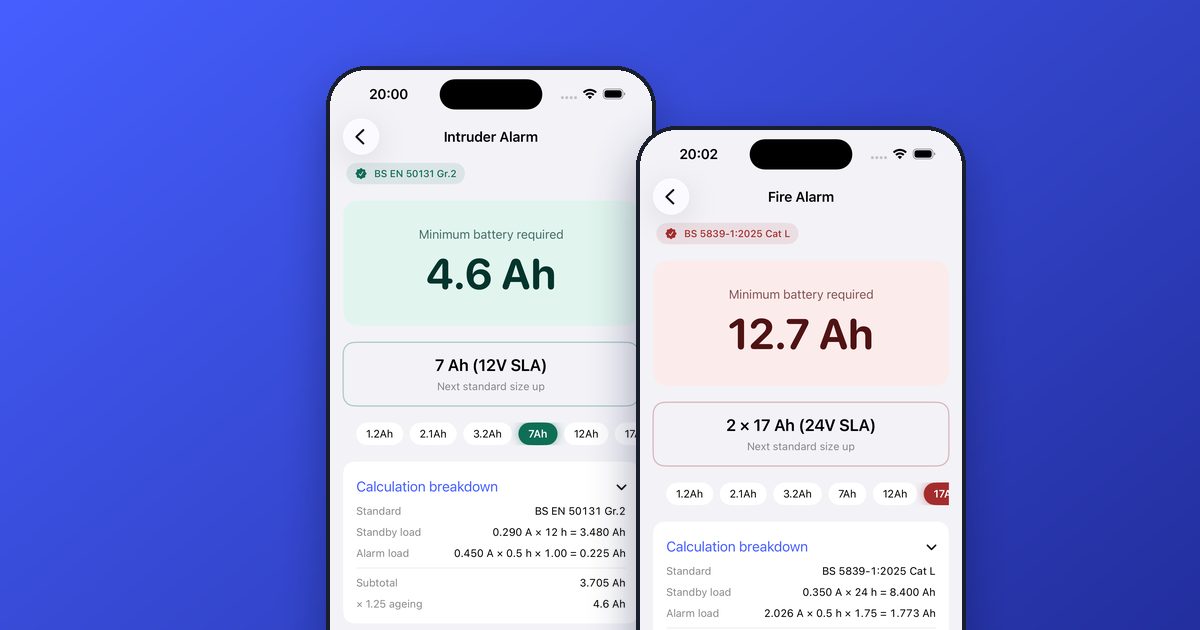
Every fire and intruder alarm system needs to keep working when the mains fails, and the battery is what makes that possible. Get the size wrong and you have one of two problems: a battery that cannot carry the system through the required standby period, or an oversized battery that does not fit in the enclosure and costs more than it should.
The sums themselves are not difficult. The harder part is knowing which standby period applies, which factors to include, and what to do with the answer. This guide sets out the general method, shows how the numbers work in a worked example, and lists the mistakes that tend to catch people out.
The basic method
A standby battery calculation answers one question: how much charge does the battery need to hold so that the system runs on standby for the required period and then still has enough left to sound the alarm?
The general form is:
Minimum capacity = ageing factor × [ (standby current × standby period) + (de-rating factor × alarm current × alarm period) ]
Currents are in amps and periods are in hours, so the result is in amp-hours (Ah). If your data sheets give milliamps, divide by 1,000 first.
Standby current
This is the total current the system draws from the battery when it is sitting quietly with no alarm condition. Add up the panel or control unit, keypads, detectors, interface modules and anything else on the supply. Use the manufacturer's quiescent figures, and do not forget devices that are easy to overlook, such as communicators and expanders.
Alarm current
This is the total current drawn when the system is in alarm: sounders, beacons, flashing indicators and any detectors or modules that draw more in alarm than on standby. Use the worst case the system could reach, not the average.
Standby period and alarm period
The standby period is how long the system must run with no mains. The alarm period is how long it must then sound the alarm. Both come from the standard or specification that applies to the installation, so they are the figures most worth checking rather than assuming. We cover the values StandbyCalc uses further down.
De-rating factor
Batteries deliver less usable capacity when they are discharged quickly. Alarm current is typically much higher than standby current, so some calculation methods multiply the alarm load by a de-rating factor to allow for this. Not every method applies one to every system type, so check what your standard and specification call for.
Ageing factor
A new battery is at its best. As it ages its capacity falls, and the system still has to meet its requirements at the end of the battery's service life. An ageing factor multiplies the total to build in that margin.
Rounding up
The calculated figure is a minimum. Batteries come in fixed sizes, so you pick the next size up from the list the panel supports. Never round down, and check that the battery physically fits the enclosure.
Standby and alarm periods by system type
The periods depend on the type of system. These are the values that StandbyCalc uses, which are its interpretation of the published standards. They are not a substitute for reading the standard.
Intruder alarms
For intruder systems, StandbyCalc is based on BS EN 50131 (and BS 9263), with BS 4737 also available. It uses these standby periods:
- BS 4737: 8 hours
- Grades 1 and 2: 12 hours
- Grade 2X (bells only, no ARC): 12 hours
- Grades 3 and 4: 60 hours, or 30 hours where the system reports mains failure to an alarm receiving centre (ARC)
In every case StandbyCalc uses an alarm period of 30 minutes, a de-rating factor of 1.0 on the alarm current and an ageing factor of 1.25.
Fire alarms
For fire systems, StandbyCalc is based on BS 5839-1 and covers Categories L, M and P. It uses:
- A default standby period of 24 hours
- 6 hours where a standby generator is present
- For Category P in an unoccupied premises, 24 hours plus the unoccupied period, capped at 72 hours
- An alarm period of 30 minutes
- A default de-rating factor of 1.75 on the alarm current, which can be adjusted
- An ageing factor of 1.25
Standards are revised from time to time, and clauses change in meaning as well as in number. Check the current edition and your system specification, and confirm the figures with the person responsible for the installation or a qualified engineer.
A worked example (example only)
This example uses the same logic as StandbyCalc for a Category L fire system with no generator and a 24 V panel. The currents are made up for illustration. They do not describe any real panel, and you must use the data for your own equipment.
- Standby current: 120 mA (0.12 A)
- Alarm current: 450 mA (0.45 A)
- Standby period: 24 hours
- Alarm period: 0.5 hours
- De-rating factor: 1.75
- Ageing factor: 1.25
Step 1, standby load: 0.12 A × 24 h = 2.88 Ah
Step 2, alarm load: 1.75 × 0.45 A × 0.5 h = 0.394 Ah (rounded)
Step 3, subtotal: 2.88 + 0.394 = 3.274 Ah
Step 4, apply the ageing factor: 3.274 × 1.25 = 4.09 Ah
Step 5, round up: StandbyCalc's 24 V size list runs 1.2, 2.1, 3.2, 7, 12, 17, 24, 38 and 65 Ah. The next size above 4.09 Ah is 7 Ah, so the app would recommend two 7 Ah batteries for a 24 V system.
Notice how much the standby load dominates. The alarm load is small because the alarm period is short. That is typical, and it is why a few extra milliamps of standby current can push you into the next battery size, while a large change in alarm current often makes little difference.
Common mistakes
Forgetting a device
One missed expander or communicator can be enough to change the answer. Walk through the whole system, including anything powered from the same supply.
Using the wrong current figure
Mixing up standby and alarm figures, or using a typical value where the manufacturer gives a maximum, makes the whole calculation unreliable. Take the figures from current data sheets and write down where they came from.
Mixing up milliamps and amps
This is the classic arithmetic slip. A figure of 120 mA is 0.12 A. Enter it as 120 and the answer is a thousand times too large.
Applying the wrong period
Intruder grade, ARC reporting, generator presence and premises occupancy all change the standby period. Check that the period you used matches the system you are actually installing.
Ignoring the physical battery
The recommended size has to fit the enclosure, work with the charger in the panel or power supply, and be a battery type the manufacturer supports. A result on paper is not the end of the job.
Not keeping a record
When a system is inspected or revisited, a written calculation showing the inputs, periods and factors saves a lot of time. Record it with the installation paperwork.
Doing it on site
You can do all of this on a calculator or in a spreadsheet, and many engineers do. The advantage of a purpose-built tool is that the periods and factors are pre-filled for the system type, the arithmetic is done for you and the working is shown.
We built StandbyCalc, a free iOS app, for that reason. You pick intruder, fire or standalone PSU, enter the currents, and it shows the full breakdown (standby load, alarm load, ageing factor and recommended standard battery size). A one-time Pro upgrade adds PDF reports with your company branding and iCloud sync. The standalone PSU option lets you set your own standby and alarm periods for equipment that falls outside the standard grades.
StandbyCalc is a working aid. It does not replace the standard, your specification or your own judgement, and you remain responsible for checking the result.
Frequently asked questions
What is the formula for a standby battery calculation?
Multiply the standby current by the standby period, add the alarm current multiplied by the alarm period (with a de-rating factor if one applies), then multiply the total by an ageing factor. Round the result up to the next available battery size. The periods and factors come from the standard that applies to the system, such as BS EN 50131 for intruder systems and BS 5839-1 for fire systems, so check the current edition.
Why do I need an ageing factor?
A battery loses capacity as it gets older, and a battery sized to the bare minimum on day one will fall short before the end of its service life. An ageing factor adds margin to cover that. Check the current standard and your system specification for the value you should use.
Do I need two 12 V batteries for a 24 V fire alarm panel?
Many 24 V panels use two 12 V batteries in series. Each battery needs to meet the calculated capacity, because the same current flows through both. Always check the panel manufacturer's instructions for the battery arrangement it supports.
Is the standby period the same for every intruder alarm?
No. It depends on the standard and grade, and on whether the system reports mains failure to an alarm receiving centre. For reference, StandbyCalc uses 8 hours for BS 4737, 12 hours for Grades 1 and 2 and Grade 2X, and 60 hours for Grades 3 and 4, falling to 30 hours for Grades 3 and 4 with ARC mains-fail reporting. Confirm the requirement against the current standard and your specification.
Can a calculator replace the standard?
No. A calculator saves time and reduces arithmetic mistakes, but the design decisions belong to you and the person responsible for the system or a qualified engineer. Use the standard and the manufacturer's data as your reference, and treat any calculator result as a working figure to check.
BS EN 50131, BS 9263 and BS 5839-1 are published by BSI. StandbyCalc is an independent app, not affiliated with or endorsed by BSI.