If you are the responsible person for a building, emergency lighting is one of those systems that only gets attention when something goes wrong. The lights sit there for months, and then a fire alarm goes off in the dark or an inspector asks to see your log book. At that point you want a clear record that the system has been tested and that any faults were dealt with.
This guide covers the routine most UK premises follow: the monthly functional (flick) test, the annual full-duration test, what to do when a light fails, and how to keep a light register and log book that stands up when someone asks to see it. It is general advice for responsible persons and facilities managers, not a substitute for the current standard or for advice from a competent emergency lighting engineer.
The two routine tests, in plain terms
Emergency lighting guidance in the UK is built around BS 5266-1, the code of practice for emergency lighting of premises. It is published by BSI, and you should always read the current edition rather than rely on a summary like this one. In everyday practice, routine testing comes down to two things.
The monthly functional (flick) test
The monthly test is a short check that every emergency light and illuminated exit sign actually switches to its emergency mode and lights up. Sometimes called a "flick test", it is usually done by operating a test switch or key, or by briefly isolating the lighting circuit, so the lights run from their batteries for a short time.
The point is simple: walk the building, look at every fitting, and note which ones are lit. A lamp that has failed, a sign that has gone dark or a fitting that was never reconnected after building work will show up straight away.
A few practical points:
- Pick a regular day. A fixed day each month, such as the first Monday, makes it harder to forget.
- Choose a quiet time. Testing puts the system on battery, so avoid times when the building is busy or when people rely on the lighting.
- Test every light, not a sample. The monthly test is about finding the one fitting that has failed.
- Restore the supply and check. Make sure everything has returned to normal and any indicators are showing healthy afterwards.
- Note anything you could not reach. A light above a locked room or behind stored stock has not been tested, and your record should say so rather than imply otherwise.
The annual full-duration test
Once a year, the system needs a test that runs the lights for their full rated duration, to prove the batteries can still do the job they were installed for. The duration depends on how the system was designed for your building, for example 1 hour or 3 hours, so check your system's documentation or ask your engineer.
This test is more disruptive than the monthly one, and it drains the batteries. A few things to plan around:
- Recharge time. Batteries need time to recharge afterwards, and the building may have reduced emergency cover until they do. A common rule of thumb for self-contained lights is around 24 hours, but check the manufacturer's guidance for your fittings.
- Temporary cover. If the building cannot be left with weakened emergency lighting while batteries recharge, you may need to plan temporary measures. This is a question for your fire risk assessment and your competent person.
Testing the building in two halves
Some buildings split the annual test into two halves, which we will call A and B, tested on different days. The idea is that at any moment, half the lights are on full charge and still available if something happens while the other half recharges. It is an option, not something you have to do. Whether it suits your building is a decision for you, your fire risk assessment and your competent person.
If you do split the test, the thing to watch is that group B does not get forgotten. Record which lights belong to which group, and make a note to follow up if the second half is still outstanding a week later. Any lights you could not reach on the day count as a gap until they have been tested.
What to do when a light fails
A failed light is not a problem in itself; finding it is the point of testing. What matters is what happens next, and whether you can show it. Do not leave failures sitting open.
For every failure, record:
- Which light failed, using its reference number or location.
- When and how you found it, and who was testing.
- What was done: for example a battery replaced, a lamp or LED module replaced, a fitting replaced, or a supply fault fixed.
- Any temporary measures put in place while the light was out of action, and who agreed them.
- The retest, with its date and result.
The retest is the step people most often skip. If a battery or a whole fitting has been replaced, a full-duration retest is the sensible way to show the new part actually works. For a simpler repair, a functional check may be enough, though your engineer can tell you what is appropriate. Only once the retest passes is the failure properly closed.
Keeping a light register
A light register is the list of every emergency light and illuminated sign in the building. Without one, you cannot be sure you are testing everything, and a missing fitting will never get noticed.
A useful register has one line per fitting, covering:
- A reference number, ideally matching a label on the fitting or a mark on the floor plan
- The area and a short description of the location
- Whether it is a luminaire or a lit sign
- The mode of operation, such as maintained or non-maintained
- The supply type, such as self-contained or central battery
- The rated duration
- If you test in halves, which group it belongs to
Keep the register up to date. When a fitting is added, moved or removed, change the register the same day. A register that no longer matches the building is worse than none, because it gives false confidence.
What a good log book contains
The log book is the evidence. When a fire risk assessor, insurer or enforcing authority asks how you look after your emergency lighting, this is what you show them. As a minimum it should cover:
- Every monthly test, with the date, who carried it out and the result for each light
- Every annual test, with start and end times and the result
- Every failure, with the action taken and the retest
- Service visits and alterations to the system
- Any shutdown, fault or period when the system was out of use
Two habits make the biggest difference. First, sign and date every entry at the time, not weeks later from memory. Second, never rewrite history: if you spot a mistake, add a correction and say what changed. A log book with clearly marked corrections is far more credible than one that looks too tidy.
Paper log books work fine if they are kept at the building and actually filled in. Their weak points are that they get lost or damaged, they are awkward to search, and a page of monthly entries is easy to leave blank without anyone noticing. A digital record can remind you when a test is due and produce a printable copy on demand, but only if it records the same things a good paper one would.
Where an app can help
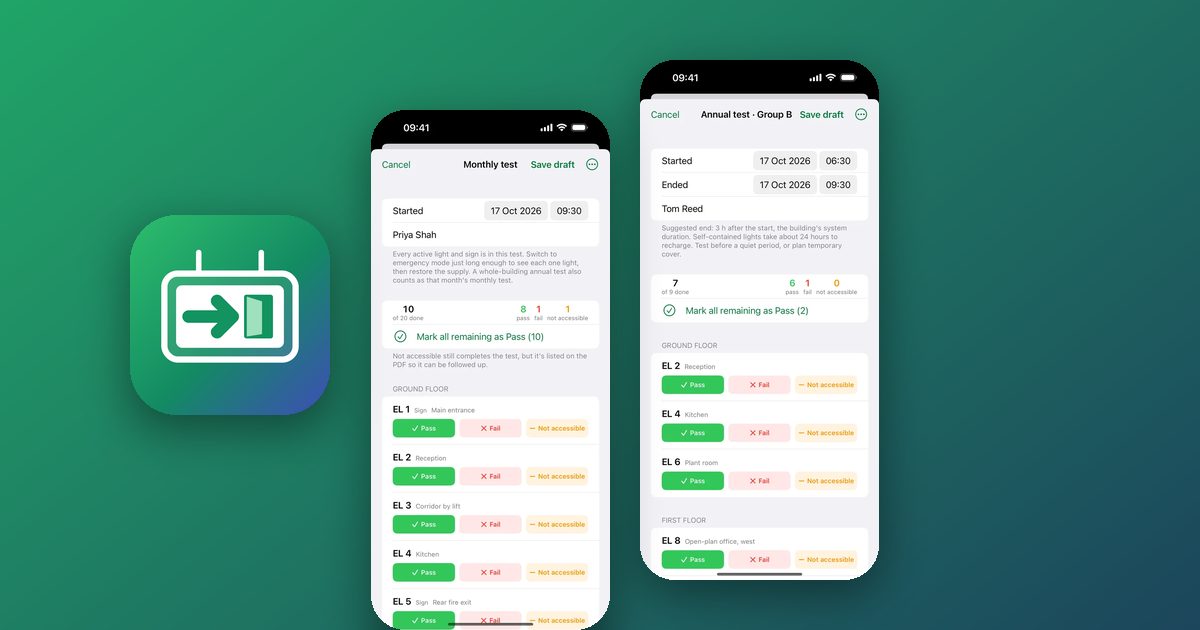
We built ExitPath, an emergency lighting log book for iPhone, for exactly this routine. It keeps a light register, puts the monthly flick test on one screen where you mark each light as Pass, Fail or Not accessible, and records the annual full-duration test, either for the whole building or in two halves. Failures carry through to a retest, and the whole log book exports as a PDF. ExitPath is coming soon to the App Store.
It is a record-keeping tool only. It does not test or inspect anything, and it does not replace the periodic inspection and test certificate from your emergency lighting engineer. Whatever you use to keep your records, paper, spreadsheet or app, the habits above are what matter.
Frequently asked questions
What is a flick test for emergency lighting?
A flick test is the common name for the monthly functional test. You put the emergency lights into emergency mode for a short time, for example with a test key or switch, and check that every light and sign comes on. It is a quick check that each fitting still works, not a test of battery duration.
How often should emergency lighting be tested?
Routine practice is a short functional test every month and a full-duration test once a year, as set out in the guidance based on BS 5266-1. Always check the current edition of the standard and the advice of your emergency lighting engineer for your own premises.
Does the annual test have to be done in one go?
Not necessarily. Some buildings test the whole system at once, and others split the annual test into two halves, A and B, on different days. Splitting is an option, not a requirement, and it is a decision for you, your fire risk assessment and your competent person. If you do split it, record which lights are in which group and make sure the second half is not forgotten.
What should an emergency lighting log book include?
At a minimum: the monthly tests with dates, who tested and the results, the annual tests, every failure with the action taken and the retest result, service visits, alterations to the system, and any period when it was out of use. A light register alongside it shows what the system consists of.
What happens if a light fails the test?
Record the failure, fix the cause (for example replacing a battery, a lamp or the whole fitting), note any temporary measures while it was out of action, and retest. If a battery or fitting was replaced, a full-duration retest is the sensible way to prove it. Only close the failure once the retest passes.
BS 5266-1 is a British Standard published by BSI. ExitPath is an independent app and is not affiliated with or endorsed by BSI. This article is general guidance and is based on the standard rather than a statement of what it requires. Check the current edition and speak to your responsible person or competent person about your own premises.